
I undertake a limited number of commissions each year, developed in the same way as the studio work. These are not treated as a separate strand of production, but as extensions of an ongoing practice grounded in observation, material research, reconstruction, and sustained attention to detail.
Projects often begin with a shared point of interest — botanical, ecological, historical, scientific, or personal — and evolve through a process of conversation, research, and careful making. The strongest collaborations allow space for interpretation and the development of new ideas, rather than the direct replication of predetermined outcomes.
Working primarily with wax and historically informed sculptural techniques, each piece develops slowly over extended periods of focused handwork. The resulting works may appear delicate or decorative at first encounter, yet they are shaped by deeper concerns surrounding preservation, fragility, environmental change, systems of display, and the relationships between living organisms and human intervention. There is more held within them than first appears.
Commissions may take the form of private works, gallery collaborations, institutional partnerships, research-led projects, or site-responsive installations. Particular interest is given to opportunities involving museums, collections, ecology, horticulture, scientific research, and collaborations capable of bringing specialised forms of knowledge into wider cultural and public conversations.
Due to the intensive nature of the process, only a small number of projects can be undertaken each year. Enquiries are welcomed from individuals and organisations who feel a genuine alignment with the practice and an understanding of the time, care, and attention each work requires.
To discuss a potential project, please get in touch via the Contact page.
Vitis vinifera L. var. ‘Arbane’
This commission was developed for a private collector in South Africa whose practice centres on the continuation of artisanal knowledge.
Sculpted in beeswax, the work depicts an Arbane vine, a rare and ancient white grape native to the Aube region of Champagne. The form draws on historic scientific illustration, supported by photographic reference material of living vines supplied by Drappier vineyard, one of the producers involved in the grape’s ongoing preservation.
Nearly lost to viticultural history due to low yields and late ripening, Arbane survives through the sustained cultivation of a small number of growers and is now undergoing a quiet resurgence. Rendered in wax, the work becomes a study of rarity, continuity, and custodianship, where botanical survival remains inseparable from human attention and time.
Materials – Beeswax, paraffin wax, steel bar, tinned copper wire, plastazote, tissue paper, cotton thread, artists’ pigments, acrylic paint, acrylic varnish. Mounted in a glass case with a metal frame, painted wooden base and hand-engraved copper label
Dimensions – 42 x 26 x 41cm
Date – 2024
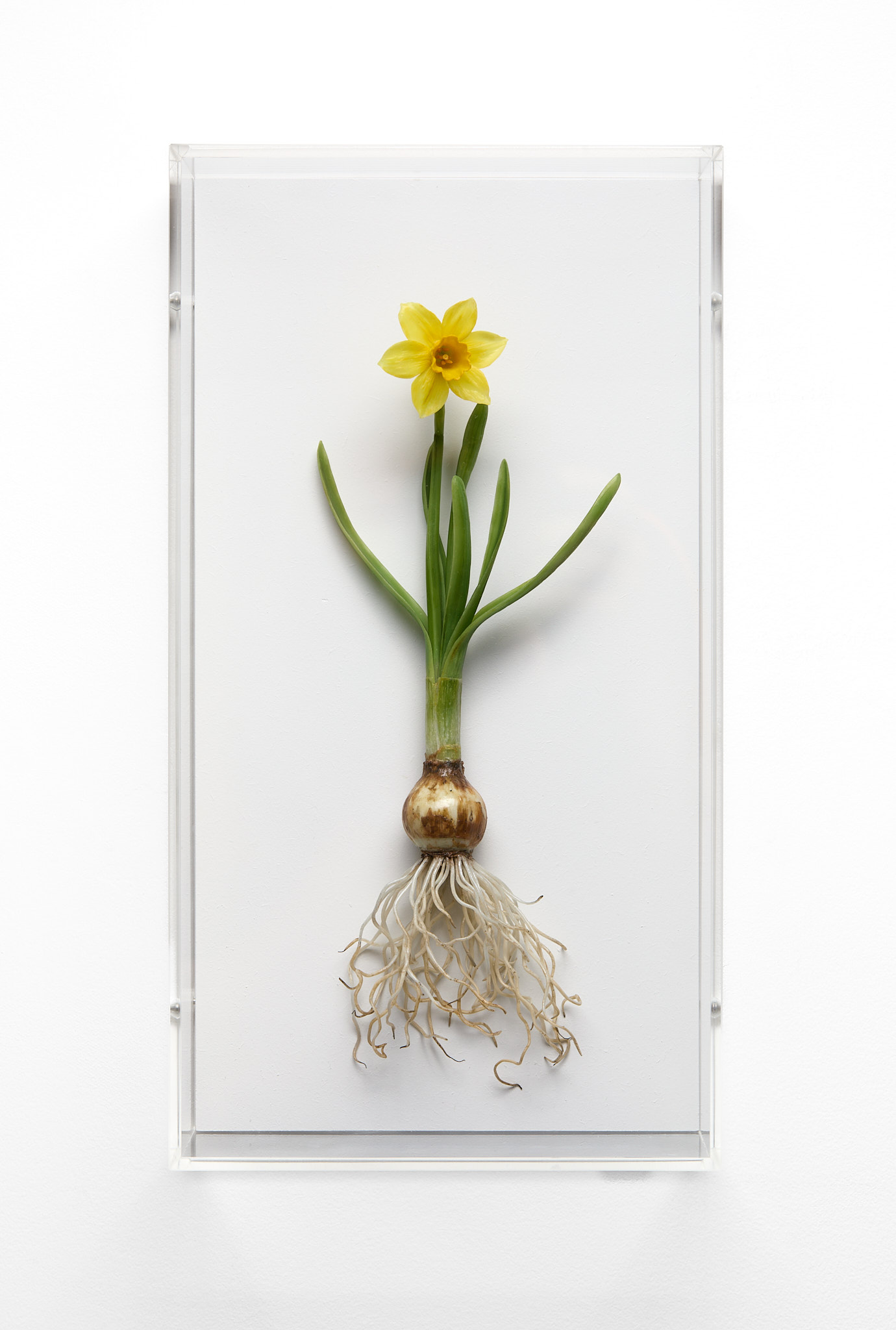
Narcissus ‘Tête-à-tête’
This commission was made for a private collector with a longstanding interest in natural history collections, exacting hand skill and material knowledge. The work was requested as a living tribute to his mother, for whom the small yellow daffodil Narcissus ‘Tête-à-tête’ holds particular significance.
Bulbs were planted in the artist’s garden in autumn and, once flowering the following spring, lifted from the soil, their roots washed clean, and used as direct reference for the work.
Sculpted in wax, the work holds the daffodil at a particular moment in its seasonal life. The flower remains delicate and familiar, but the bulb and tangled root system, usually hidden underground, are exposed, giving the piece an unexpected steadiness and substance. As a cultivated variety, Narcissus ‘Tête-à-tête’ also carries a quiet history of domestic planting, tending and nurturing.
Made for someone still present, the work is not a memorial in the usual sense. It is closer to an heirloom in advance: a small, watchful object, held by the strength of what is usually unseen.
Materials – Beeswax, paraffin wax, tinned copper wire, tissue paper, cotton thread, artists’ pigments, acrylic paint, acrylic varnish. Mounted in a bespoke acrylic case with painted wooden baseboard
Dimensions – 34 x 18 x 7.5cm
Date – 2026
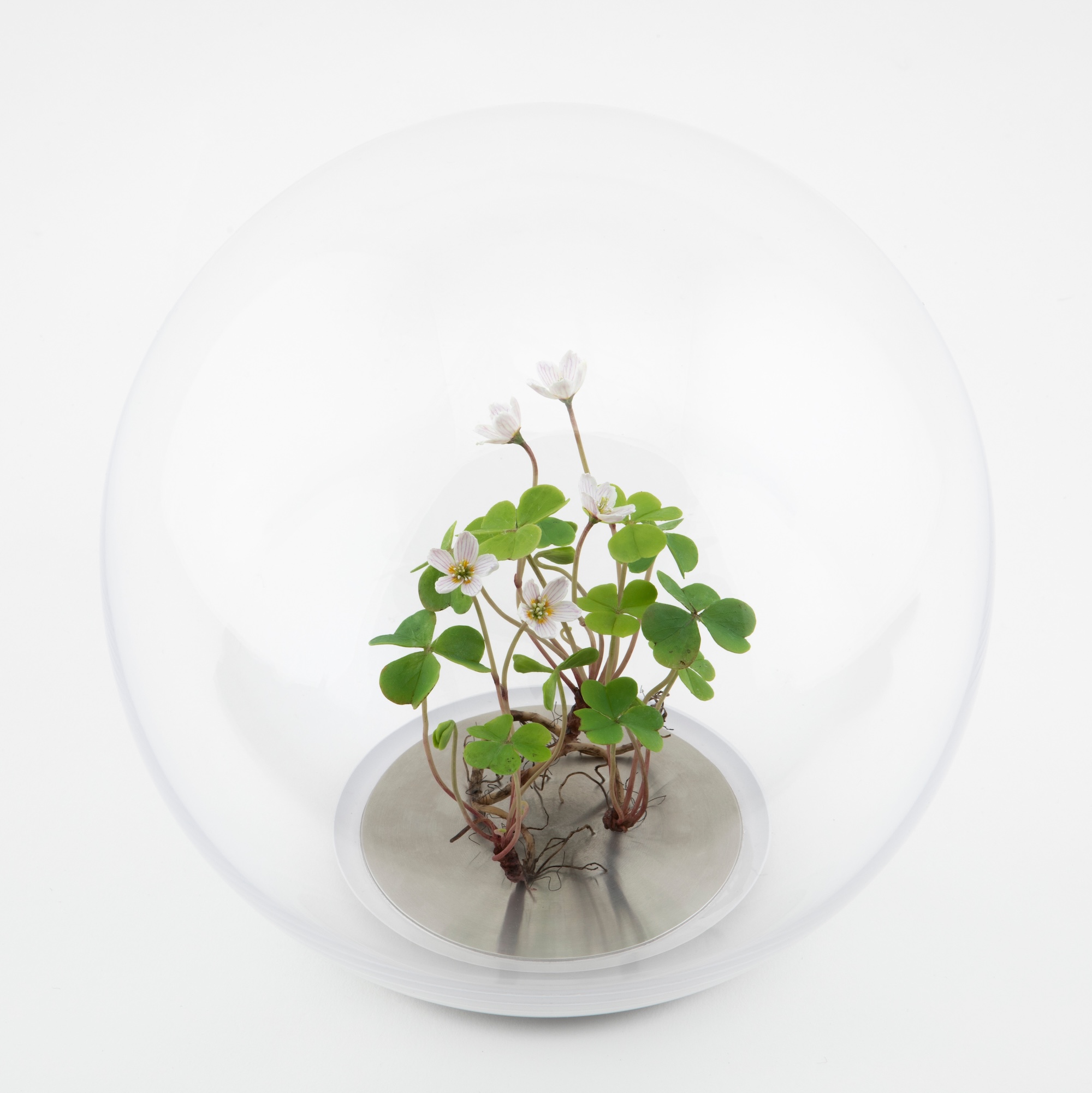
Oxalis acetosella
Commissioned through a gallery for a private client, this sculpture began with wood sorrel, a woodland plant chosen in memory of family. The client, herself an artist and plantswoman deeply connected to gardens and the natural world, was drawn to the three heart-shaped leaves for their evocative power.
Wood sorrel is a small, shade-loving plant often associated with ancient woodland. Its leaves fold back at night and its flowers close in darkness and rain. These quiet, responsive movements shaped the way the subject was understood, giving the work a sense of shelter and stillness.
The finished plant is held within a handblown glass orb on a bespoke steel base. The display protects the delicate botanical form, while preserving a meaning that remains private and contained.
Materials – Beeswax, paraffin wax, tinned copper wire, tissue paper, cotton thread, artists’ pigments, acrylic paint, acrylic varnish. Mounted on a solid, custom CNC lathed 304 stainless-steel base, inside a hand-blown glass orb
Dimensions – Approx. Ø20cm
Date – 2021